

Time moves forward. You spill coffee and it spreads across the table — it does not leap back into the cup. Ice melts, stars age, entropy accumulates. This one-way direction of time is so fundamental to our experience of reality that it barely seems worth questioning. And yet physicists have been quietly picking at this assumption for over a century. Now a team at Los Alamos National Laboratory has done something striking: they have built a set of quantum tools that can make a physical system behave as though time is running in reverse — and while doing it, pull usable energy out of the process.
The Arrow of Time — and Why Quantum Physics Challenges It
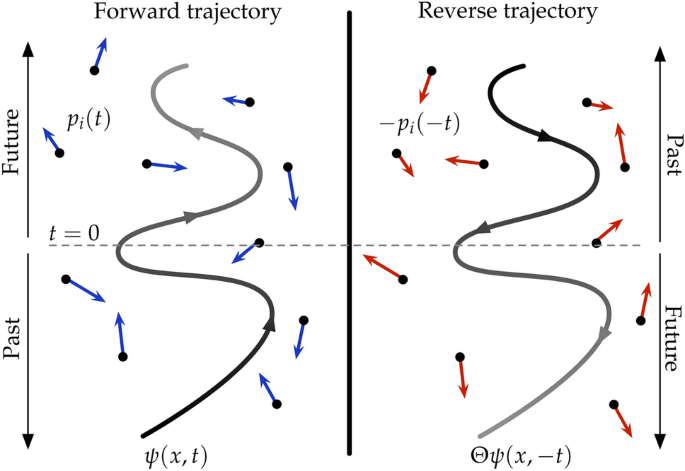
To understand what the Los Alamos team accomplished, it helps to understand what physicists mean by the arrow of time. At the level of fundamental equations, the laws of physics are largely symmetric — they work just as well going forward as they do going backward. A video of two billiard balls colliding looks plausible whether you play it forward or in reverse. But the moment you zoom out to complex systems — a breaking wave, a burning candle, a warm room slowly cooling — that symmetry breaks. Nature overwhelmingly favors one direction. Entropy increases. Disorder accumulates. Time has an arrow.
In quantum physics, that arrow emerges in a specific and measurable way: through the act of measurement. Each time you observe a quantum system, you extract information from it, and that extraction nudges the system in a particular statistical direction — forward in time. The pattern of measurements and their outcomes is what creates quantum time’s arrow. Crucially, this also means the arrow is not hardwired. It is a consequence of how measurement works. And if you can control how measurement works, you can potentially reshape the arrow itself.
What the Los Alamos Team Actually Built
The research, published in Physical Review X, was led by physicist Luis Pedro García-Pintos and colleagues at Los Alamos National Laboratory in New Mexico, working alongside researchers at NIST and the University of Maryland.
Their approach centers on a specially constructed mathematical tool called a control Hamiltonian — essentially a set of instructions for how to manipulate a quantum system in real time. The key insight is this: every time a quantum system is measured, it receives a small disturbance. Normally those disturbances accumulate in a way that drives the system forward in time. But if you precisely track those disturbances and apply a carefully designed counterforce after each measurement, you can cancel them — or even overcompensate for them, generating trajectories that look statistically more consistent with time running backward than forward.
The team called this a protocol for engineering time-reversed stochastic trajectories. In practical terms, it means the quantum system’s behavior starts resembling what you would expect from a film played in reverse.
They did not actually break any laws of physics. Time is not literally flowing backward in their laboratory. What they demonstrated is that the statistical signature of the arrow of time — the thing that makes quantum processes look irreversible — can be suppressed, blurred, or inverted using the right control techniques.
Maxwell’s Demon, Resurrected
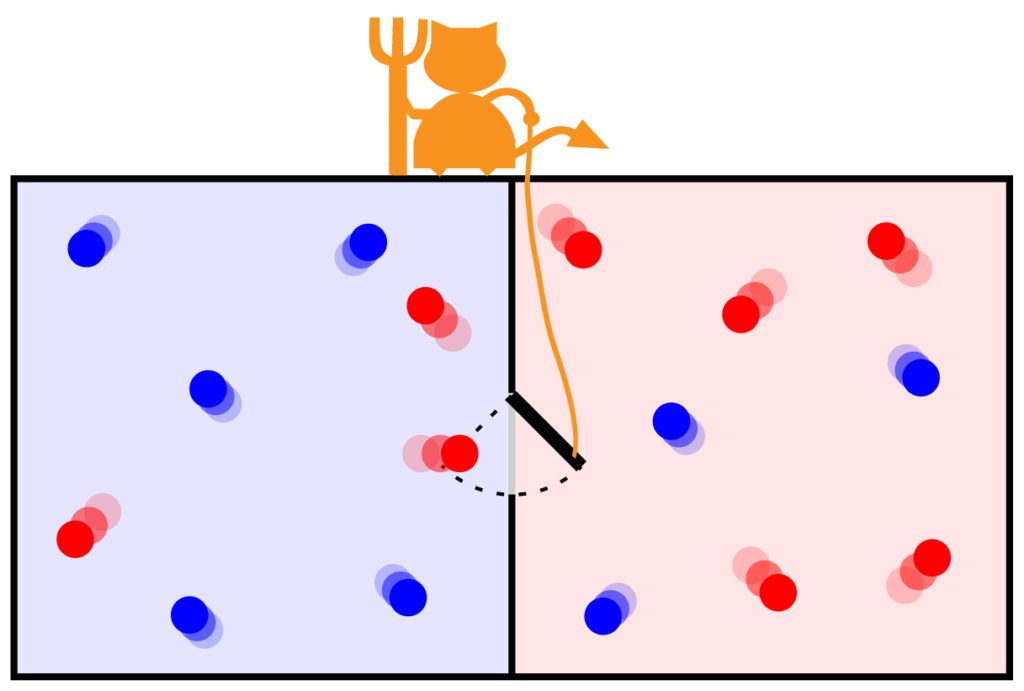
The most immediately striking application of this work is energetic. The team used their control protocols to build what physicists call a quantum Maxwell’s demon — a reference to a famous 19th-century thought experiment by James Clerk Maxwell.
In Maxwell’s original thought experiment, a tiny imaginary demon sat at a door between two chambers of gas, selectively letting fast molecules through in one direction and slow molecules in the other. By using information — knowledge of which molecules were which — the demon appeared to reduce entropy without doing any work, seemingly violating the second law of thermodynamics. The resolution, worked out over decades, is that the act of acquiring and erasing information carries its own thermodynamic cost. Information is not free.
The Los Alamos team’s quantum demon exploits exactly this principle in reverse. Because every measurement performed on a quantum system injects a small amount of energy into it, their control protocols can redirect that injected energy and extract it as useful work. The result is a continuous measurement engine — a device that harvests energy directly from the process of observing a quantum system.
Why This Matters Beyond the Laboratory
The immediate applications the researchers have in mind are practical ones. Quantum computers are extraordinarily sensitive machines — maintaining the fragile quantum states inside a qubit requires constant monitoring, and that monitoring itself introduces noise and energy costs. Protocols that can undo the disturbing effects of measurement, or extract energy from them rather than simply losing it as heat, could meaningfully improve quantum computer performance and efficiency.
Further ahead, the same principles could apply to quantum batteries — devices that store energy in quantum states rather than chemical reactions — and to miniature quantum engines designed to operate at scales where quantum effects dominate.
The next step for the team is experimental: testing these protocols in real superconducting qubit hardware, where measurement speeds and feedback precision are already advanced enough to implement what has so far existed only as theory and simulation.
Time, in the classical world, remains stubbornly one-directional. But at the quantum scale, the direction of time turns out to be something you can negotiate with — and, it seems, profit from.