
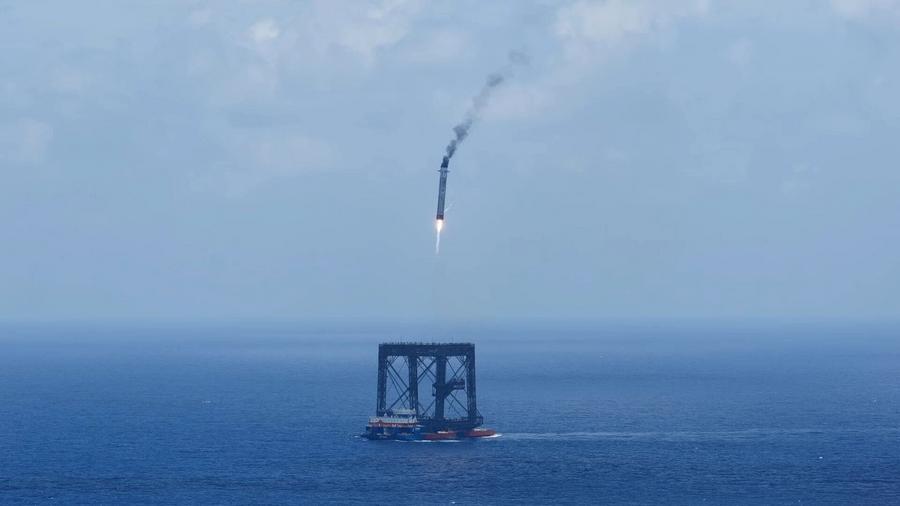
On the morning of July 10, 2026, over the South China Sea, the first stage of a Long March 10B rocket fell back through the sky, deployed four metal hooks, and let itself be caught by a cable net stretched across the deck of a waiting ship. Six minutes after stage separation, the recovery was confirmed. With that single catch, China became the second nation in history to retrieve an orbital-class rocket booster intact — and the first program anywhere to do it without landing legs.
It was a milestone a decade in the making, and it landed at exactly the right moment to reshape how the world thinks about the future of space access.
What Happened, Exactly
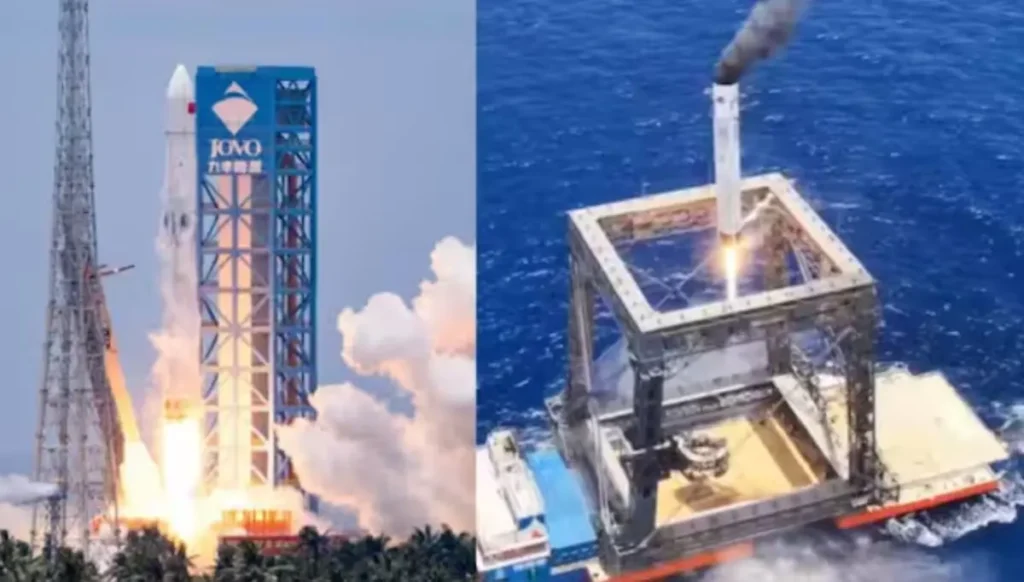
The Long March 10B lifted off at 12:15 a.m. Eastern Time from the Hainan Commercial Space Launch Site on the southern island province of Hainan. The rocket is a two-stage vehicle standing about 207 feet tall, with a first stage burning kerosene and liquid oxygen and a second stage using liquid oxygen and liquid methane. The payload — a satellite whose details were not publicly disclosed — successfully reached its planned orbit. Then the first stage turned around and came home.
The booster was caught by the Linghang Zhe — Chinese for “Navigator” — a dedicated recovery vessel positioned approximately 430 kilometers downrange. As it descended, a rocket-mounted hook deployed and connected with tension cables, slowing it down so a system of nets could catch it. Once captured, the cable system absorbed the remaining momentum, and auxiliary cables kept the booster steady amid waves and wind as an automated locking platform clamped it into place for transport.
CASC called it the world’s first net-based recovery of an orbital-class launch vehicle — a distinction no independent source has disputed.
A Different Solution to the Same Problem
The comparison everyone reaches for is SpaceX’s Falcon 9, which has been landing its boosters vertically on legs — on drone ships or on land pads — since December 2015. But the Long March 10B takes a fundamentally different engineering approach, and that difference is worth understanding.
“Net-based recovery helps simplify the rocket’s onboard structure, reduces vehicle mass and increases payload capacity. It is also highly adaptable to landing-point deviations, as coordinated net systems can effectively expand the capture window,” CALT expert Chen Muye told state agency Xinhua.
In plain terms: landing legs are heavy. Removing them from the rocket and shifting that complexity to the recovery ship frees up mass that can be converted into payload capacity. Four LiDAR units around the recovery structure track the booster’s position and attitude during final approach, and the process runs automatically without a crew inside the capture zone. It is a bet that smart ground infrastructure can outperform smart onboard hardware — and on July 10, that bet paid off.
Why This Matters Beyond the Footage
A single successful recovery is not a reusable launch program. SpaceX did not become the dominant launch provider by landing one Falcon 9. It did it by landing Falcon 9 boosters more than 600 times — with individual boosters flying as many as 36 times — and compressing the turnaround between flights to as little as 14 days. That is the operational cadence China is now trying to build toward.
The stakes extend well beyond cost competitiveness. The Long March 10B shares its first stage with the Long March 10A, a rocket designed to launch the new Mengzhou crew spacecraft to low Earth orbit. The full tri-core Long March 10 will be used to launch astronauts and a landing stack to the Moon, with China committed to putting astronauts on the lunar surface before 2030. Every successful booster recovery on the 10B validates the propulsion, guidance, and structural systems that the crewed lunar program depends on.
CASC has stated it intends to refly the recovered first stage before the end of 2026 — which would be the real test. Catching a booster once proves the concept. Catching it, inspecting it, and launching it again on a reliable schedule proves the program.
The Broader Chinese Reusable Rocket Picture
The Long March 10B did not arrive in isolation. Other partially reusable Chinese rockets are also in development, including CASC’s Long March 12A and Landspace’s commercial Zhuque-3. Both debuted in December 2025, reached orbit as planned, but their first stages did not stick the landing. The Long March 10B succeeded on its maiden flight where those vehicles fell short — making it, according to multiple tracking sources, the first orbital launch system in history to achieve first-stage recovery on its very first flight.
What Comes Next
Beijing has been consolidating its space sector at an institutional level throughout 2026, placing more than 100 space-computing organizations under a new committee and tying orbital ambitions directly to the national Five-Year Plan. That structural coordination gives China an advantage that is harder to replicate than any single piece of hardware: the ability to align commercial, scientific, and military space programs around shared timelines.
The global launch market has been SpaceX’s to lose for the better part of a decade. By now, SpaceX’s Falcon 9 launches around 150 times a year — roughly three times a week — with its booster reused dozens of times as needed. Closing that gap will take years of iteration, not a single successful catch at sea. But on July 10, China crossed a threshold that only one other nation had ever crossed. The next decade in space just got considerably more competitive.