Researchers at the University of Ottawa and the Max Planck Institute for the Science of Light have demonstrated for the first time that sunlight can be used to generate quantum-entangled photon pairs. The study, published in the journal Optica in August 2026, challenges a long-held assumption in quantum physics: that lasers are a necessary requirement for producing quantum entanglement. The finding opens a path toward more energy-efficient and accessible quantum technologies, particularly for use in space.
What Quantum Entanglement Is and Why It Matters
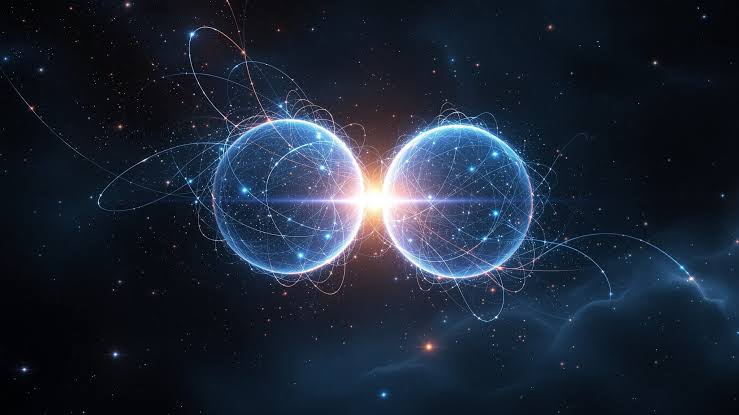
Quantum entanglement is a phenomenon in which two particles become correlated in such a way that measuring one instantly provides information about the other, regardless of the distance between them. This property has no equivalent in classical physics and is one of the foundational resources of quantum technology.
Entangled photons — pairs of light particles in this linked state — are used in quantum communication, quantum computing, and quantum sensing. They are currently produced using a process called spontaneous parametric down-conversion, or SPDC, in which photons from a pump light source pass through a nonlinear crystal and are converted into correlated pairs. For decades, lasers have been considered the only viable pump source for this process, because of their coherence, directionality, and high intensity. Sunlight, being spectrally broad, spatially diffuse, and incoherent, was widely regarded as unsuitable.
How the Experiment Worked
The research combined theoretical work from Professor Robert Boyd’s group at the University of Ottawa with a new solar concentrator developed by Dr. Hanieh Fattahi’s team at the Max Planck Institute for the Science of Light in Germany.
The core engineering challenge was delivering enough sunlight, with sufficient intensity and control, onto a nonlinear crystal roughly one millimeter in size. To solve this, Fattahi’s team built a cone-shaped all-glass solar concentrator. The device collects sunlight gathered by a Fresnel lens covering approximately 1.4 square meters — comparable in size to a large window — and channels it through an optical fiber about as wide as a human hair, directing it onto the nonlinear crystal where entanglement is generated. A solar-tracking motor kept the lens oriented toward the sun throughout the experiment.
The detection equipment, including single-photon detectors, was housed inside an optical enclosure placed within a blackout tent to block ambient light from interfering with the measurements.
What the Results Showed
Outdoor field tests were conducted over three days at the Max Planck Institute for the Science of Light in Erlangen, Germany. The team used quantum state tomography — a technique that reconstructs the full quantum state of a system from measurement data — to characterize the photon pairs produced by the setup.
The entangled photons generated from sunlight achieved a fidelity of approximately 94 percent relative to a perfectly entangled state. The photon pairs also violated Bell’s inequality, the standard statistical test used to confirm that observed correlations are genuinely quantum in origin rather than a product of classical effects. The violation was measured at 2.49 standard deviations above the classical threshold.
When differences in the bandwidth of the input light are accounted for, the efficiency of the sunlight-based approach was found to be comparable to conventional laser-based systems. The team notes that the slight shortfall in entanglement quality relative to the best laser-driven sources is attributable to distortions introduced by optical components, rather than any fundamental limitation of sunlight as a pump source.
Potential Applications
The researchers point to space-based quantum communication as the most immediate area of application. Satellites equipped with solar concentrators could generate secure quantum encryption keys using ambient sunlight, reducing or eliminating the need for onboard lasers and their associated power systems. For spacecraft, where mass and power consumption are tightly constrained, this represents a meaningful practical advantage.
On Earth, the approach could support quantum technology deployments in locations where reliable power infrastructure is limited, or in distributed quantum networks where energy efficiency is a design priority.
The team also notes that the method is not limited to SPDC. Other nonlinear optical processes, such as four-wave mixing, could in principle also be driven by sunlight, suggesting broader potential applications in quantum photonics research.
Further work will focus on increasing the photon generation rate and improving entanglement quality through refinements to the optical components.