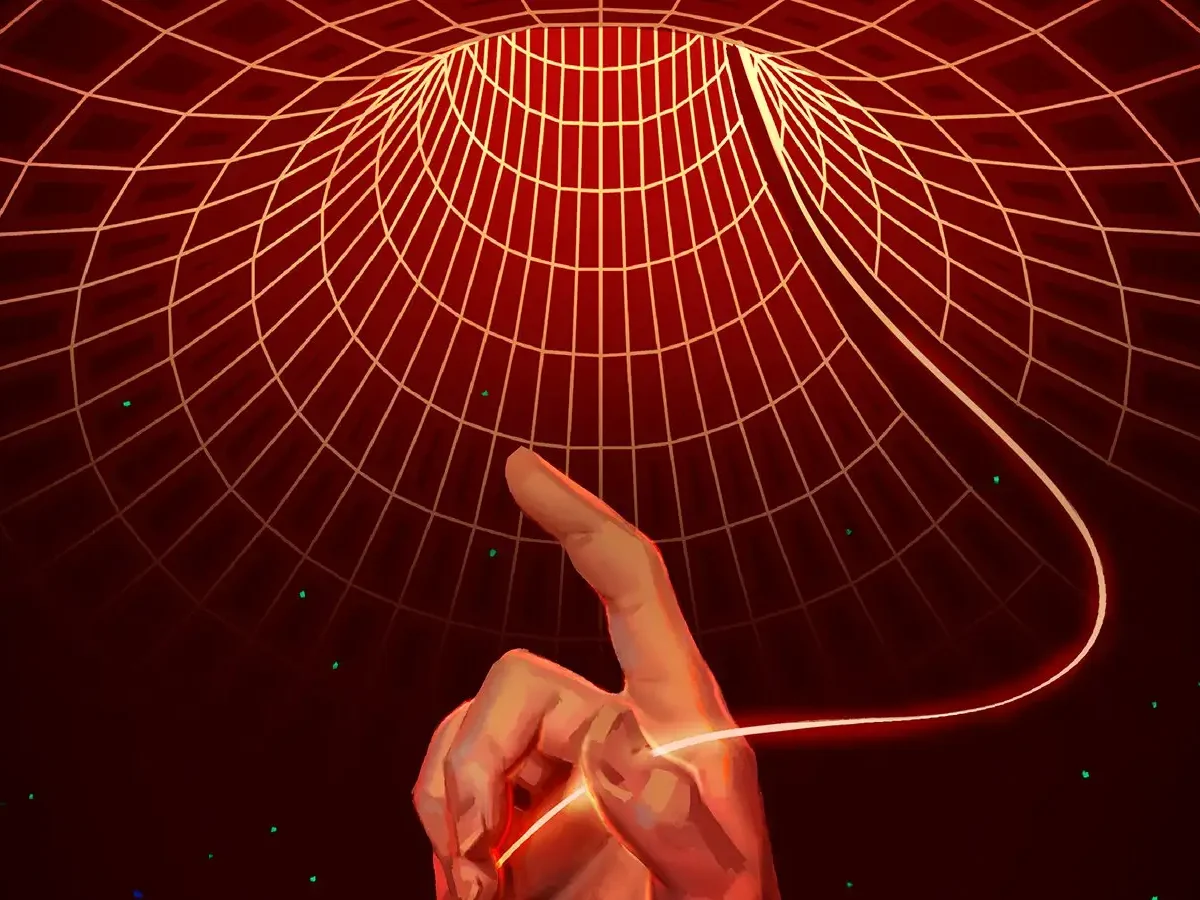
In 1973, John Archibald Wheeler captured the relationship between matter and space-time in two concise statements:
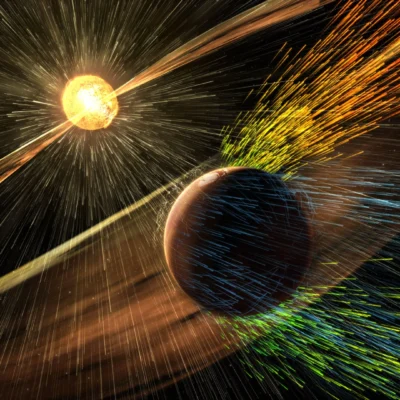
“Space acts on matter, telling it how to move. In turn, matter reacts back on space, telling it how to curve.”
These lines are often taken as a compact summary of general relativity, Einstein’s theory in which gravity is not a force but the curvature of space-time itself.
Yet Wheeler’s formulation also highlights a deeper problem that modern theorists continue to wrestle with: when building a quantum description of the universe, it has proven difficult to make space and matter interact in exactly the way general relativity demands.
Gravity as Curved Space-Time
In Einstein’s picture, gravity is geometry. A common analogy describes space-time as a stretched surface, like a mattress:
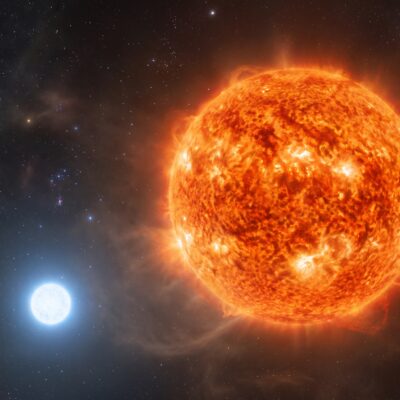
- A massive object, such as a star, acts like a heavy bowling ball placed on it, creating a depression.
- A smaller object, like a planet, moves along the curved surface, guided by that deformation.
In this picture:
matter tells space-time how to curve, and space-time tells matter how to move.
But this analogy breaks down in extreme conditions. When a star collapses into a black hole, its mass becomes concentrated into a point so dense that space-time is thought to tear. In such cases, general relativity no longer provides a complete description, signaling the need for a quantum theory of gravity.
A Quantum Reinterpretation of Space-Time
In the late 20th century, physicists discovered a promising idea: space-time itself might emerge from quantum systems.
Instead of being fundamental, space could arise from collections of interacting quantum particles. In this framework, black holes and even entire regions of space can be described in terms of particle systems arranged in specific quantum states.
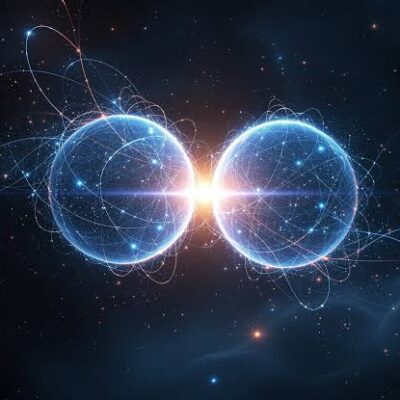
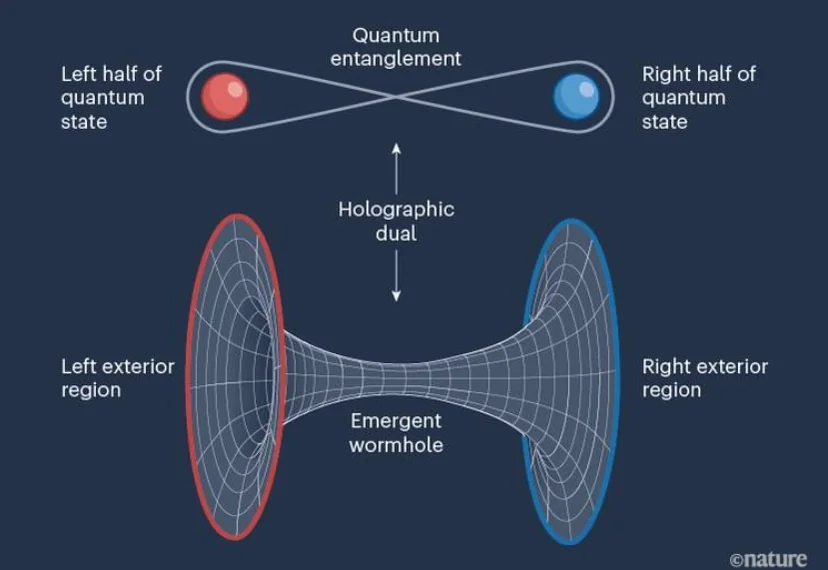
A key insight emerged: entanglement—the quantum linking of particles—appears to form the structural “fabric” of space-time itself.
For example, in holographic models, two distant regions of space can be represented by two highly entangled quantum systems. If that entanglement is reduced, the connection between the regions weakens; if it is fully removed, the spatial link disappears entirely.
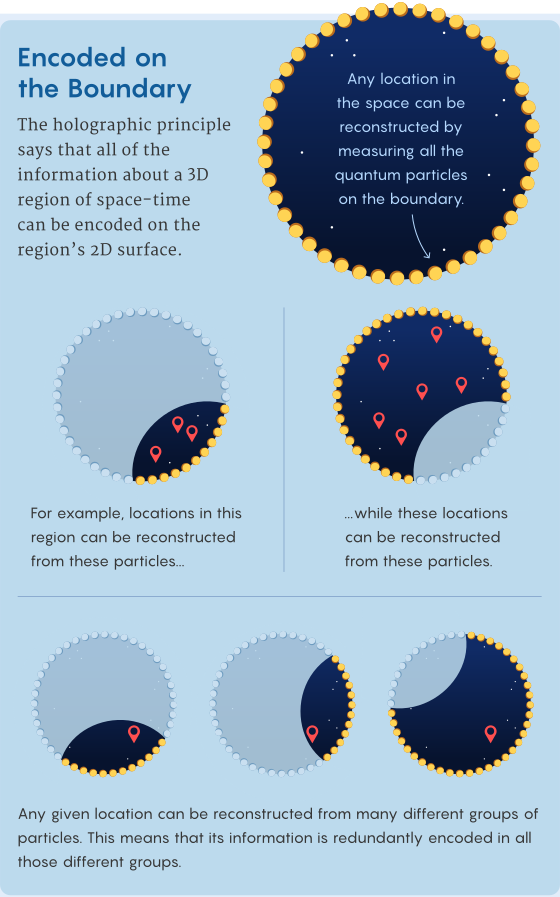
This idea is closely tied to the holographic principle, which suggests that a three-dimensional region of space can be encoded on a two-dimensional boundary, much like a hologram.
The Missing Ingredient: Why Matter Didn’t Curve Space
Despite progress, a major problem remained unresolved.
Physicists working with these quantum descriptions could explain how space emerges from entanglement. But they could not explain why matter bends space in return. In many early models, space existed—but it was rigid and unresponsive.
“We knew how to build a space-time,” said physicist Bartek Czech, “but this space-time was inert. It didn’t do anything.”
The “bowling ball” existed in the model, but it failed to dent the mattress.
Quantum Error Correction and the Structure of Space
A breakthrough came from an unexpected direction: quantum computing.
Researchers noticed that holographic space-time resembles quantum error-correcting codes, systems designed to protect fragile quantum information by distributing it across many particles (qubits).
This redundancy allows information to survive even if parts of the system are lost—similar to how a region of space can be encoded across many quantum degrees of freedom.
However, early versions of these codes had a limitation: they cleanly separated the roles of:
- entanglement (responsible for space)
- encoded data (representing matter)
Because these components were isolated, the resulting space-time could not respond dynamically. It was mathematically consistent—but physically static.
The Emergence of “Magic”
To make space-time responsive, physicist Charles Cao and collaborators began modifying these quantum codes.
They discovered that certain operations needed for the construction of more realistic quantum states involve special quantum gates known as non-Clifford gates, including the T gate.
These operations introduce computational complexity that classical systems cannot efficiently simulate. In quantum computing, this complexity is known as “magic.”
“Without magic, things are a little too simple,” said John Preskill.
Magic measures how far a quantum system is from being classically reproducible. The more “magical” a system, the harder it is to simulate without a true quantum computer.
Magic as the Source of Curvature
As researchers explored further, they found that quantum states representing curved space-time naturally contained high levels of this “magic.”
In recent work, multiple groups concluded that:
- entanglement builds spatial structure
- magic introduces flexibility into that structure
In Cao’s formulation, magic behaves like a kind of “fabric softener” for space:
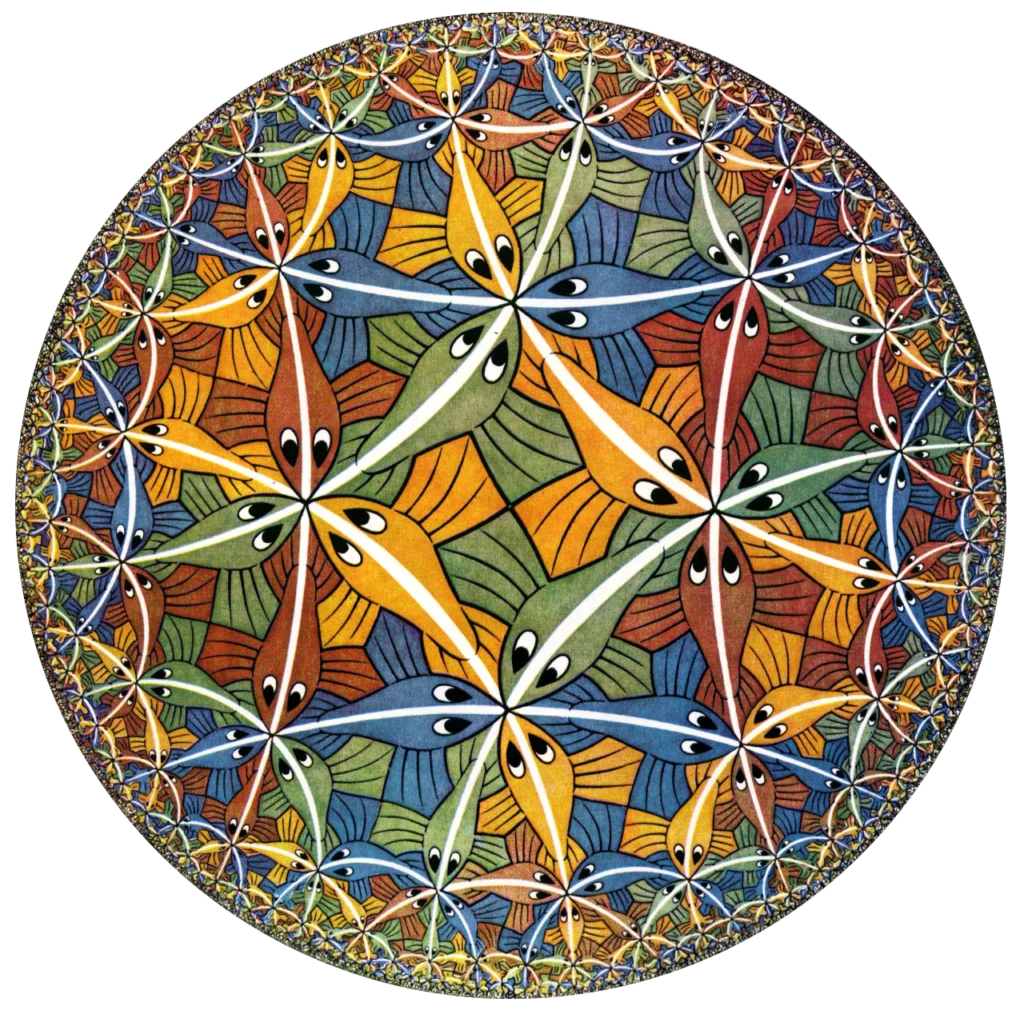
“Magic,” he calls it, “the fabric softener of space.”
In this view:
- entanglement constructs space
- magic allows space to bend
- curvature (gravity) emerges from this interplay
Or more directly:
If space is built from entanglement, gravity comes from its quantum complexity.
From Stabilized Codes to Dynamic Space-Time
Earlier quantum codes successfully mapped geometry but kept matter and space too cleanly separated. The result was a static universe—mathematically elegant, but physically incomplete.
Cao and collaborators introduced a new class of codes that incorporate large numbers of non-Clifford gates. These gates generate the required “magic,” allowing the encoded matter and space to interact.
This interaction produces a system where:
- geometry is no longer fixed
- curvature can emerge dynamically
- space becomes responsive to internal structure
Gravity as a Quantum Imperfection
One striking implication of this framework is philosophical as well as physical: gravity may arise from imperfect information encoding.
In perfectly structured quantum error-correcting codes, information is isolated and protected. But such perfection produces a rigid, non-dynamic space.
When encoding becomes slightly imperfect—when “magic” introduces mixing between components—space becomes responsive. Curvature appears.
“This is the reason Newton’s apple fell on him,” Czech said, referring to gravity as a consequence of imperfect quantum encoding.
Toward a Quantum Theory of Gravity
Cao and collaborators now see this framework as an early prototype of a deeper theory.
It does not yet describe our universe in full detail. It lacks realistic matter content, does not reproduce Einstein’s equations directly, and does not yet incorporate time evolution in a complete way.
“Right now, we are at step 0.5 of 5,” Cao said.
Still, the implications are significant. They suggest that:
- space-time is fundamentally quantum
- gravity emerges from quantum information structure
- entanglement and computational complexity are central to geometry itself
A Shift in Perspective
In this emerging picture, space-time is no longer a smooth classical stage on which physics happens. Instead, it is a quantum construct built from information processing rules.
Entanglement provides structure. Magic provides dynamics. Together, they may generate what we perceive as gravity.
As physicist Brian Swingle notes, this also suggests a practical consequence:
simulating gravity may ultimately require a quantum computer, because classical systems cannot reproduce the necessary “magic.”
Conclusion
Einstein and Wheeler described a universe where matter shapes space, and space shapes motion. Modern quantum approaches suggest something deeper: both space and gravity may emerge from the structure of quantum information itself.
In this view, gravity is not added to quantum mechanics—it is what quantum mechanics becomes when its information is allowed to mix imperfectly.
Or, as this research program suggests in its most provocative form:
space is entanglement, and gravity is its “magic.”