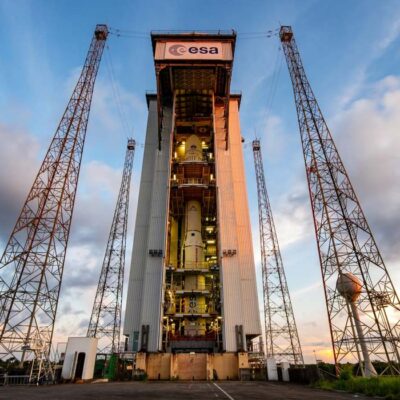

After delays, technical setbacks, and more than a few nail-biting moments at the launch pad, NASA has finally given the green light. Artemis II, the first crewed mission to reach the vicinity of the Moon in over 50 years, is officially targeting April 1, 2026, as its earliest launch date. The announcement came on March 12 following the conclusion of a two-day Flight Readiness Review at Kennedy Space Center in Florida, where mission managers unanimously determined the rocket, spacecraft, and ground systems are ready to fly.
“All the teams polled ‘go’ to launch and fly Artemis II around the Moon,” said Lori Glaze, acting associate administrator of NASA’s Exploration Systems Development Mission Directorate, at the post-review news conference. It was the kind of statement that spaceflight fans have been waiting years to hear.
A Long Road to the Pad
The journey to this moment has been anything but smooth. Artemis II was originally eyed for a launch as early as February 2026, but a series of technical issues kept pushing the date back. During a fueling rehearsal in early February, engineers discovered an unacceptable liquid hydrogen leak at the rocket’s tail service mast. Just as that problem was resolved, a second issue emerged in late February: helium was not flowing properly to the upper stage of the Space Launch System rocket. Helium is critical for pressurizing fuel tanks and purging propellant lines, and getting it wrong on the launchpad is not an option.
NASA made the difficult call to roll the entire rocket back into the Vehicle Assembly Building for repairs — a slow, painstaking process that formally pushed the launch into April. Technicians ultimately traced the helium problem to a blocked seal within a cable connecting the rocket to ground systems. Once the seal was replaced, the issue was resolved.
With the SLS and Orion now back in the VAB undergoing final preparations, the rocket is scheduled to roll back out to Launch Complex 39B on March 19. The crew will enter pre-launch quarantine at NASA’s Johnson Space Center in Houston on March 18 before traveling to Florida on March 27. If April 1 is not possible, NASA has identified backup windows on April 2, 3, 4, 5, 6, and 30. The first launch attempt on April 1 is targeted for as early as 6:24 p.m. Eastern Time.
Meet the Crew Making History

Four astronauts will make this flight. Commander Reid Wiseman, a veteran NASA astronaut and naval aviator, will lead the mission. Pilot Victor Glover, who previously flew on SpaceX’s Crew-1 mission to the International Space Station in 2020, will become the first person of color to travel to the Moon’s vicinity. Mission specialist Christina Koch will become the first woman to reach deep space and lunar distance. And Canadian Space Agency astronaut Jeremy Hansen will be the first non-American to venture that far from Earth.
Together, they represent more than just a test flight. They represent a deliberate statement about who gets to explore the cosmos.
What Artemis II Will Actually Do
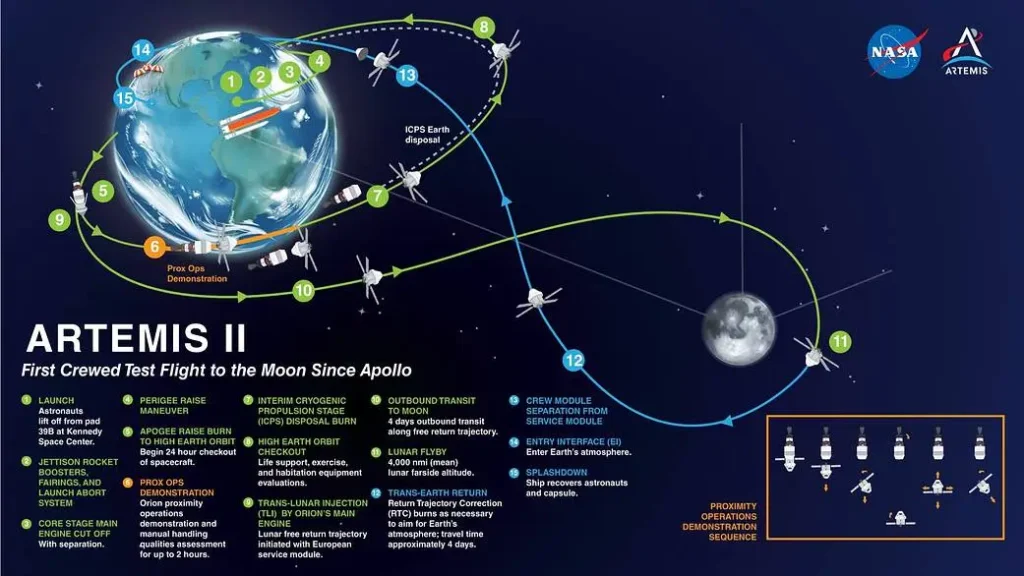
This is not a landing mission. Artemis II is a 10-day test flight designed to verify that every critical system aboard the Orion spacecraft performs as intended when real astronauts are aboard in the real environment of deep space. The crew will first enter a 24-hour checkout orbit after launch, during which they will test Orion’s life-support systems, manual piloting capability, and communications equipment. Then, if all systems check out, the spacecraft will perform a Trans Lunar Injection burn to head toward the Moon.
The crew will fly around the Moon on a free-return trajectory, passing as close as roughly 3,000 miles from the lunar surface and briefly entering a radio blackout as they swing around the far side. At its maximum distance, the mission will take the astronauts farther from Earth than any humans have ever traveled. On return, Orion will reenter Earth’s atmosphere at approximately 25,000 miles per hour — generating temperatures of nearly 5,000 degrees Fahrenheit on the heat shield — before splashing down in the Pacific Ocean.
The mission will also carry the AVATAR experiment, a set of organ-on-a-chip devices designed to study how radiation and microgravity affect human tissue, providing valuable health data for future long-duration deep space missions.