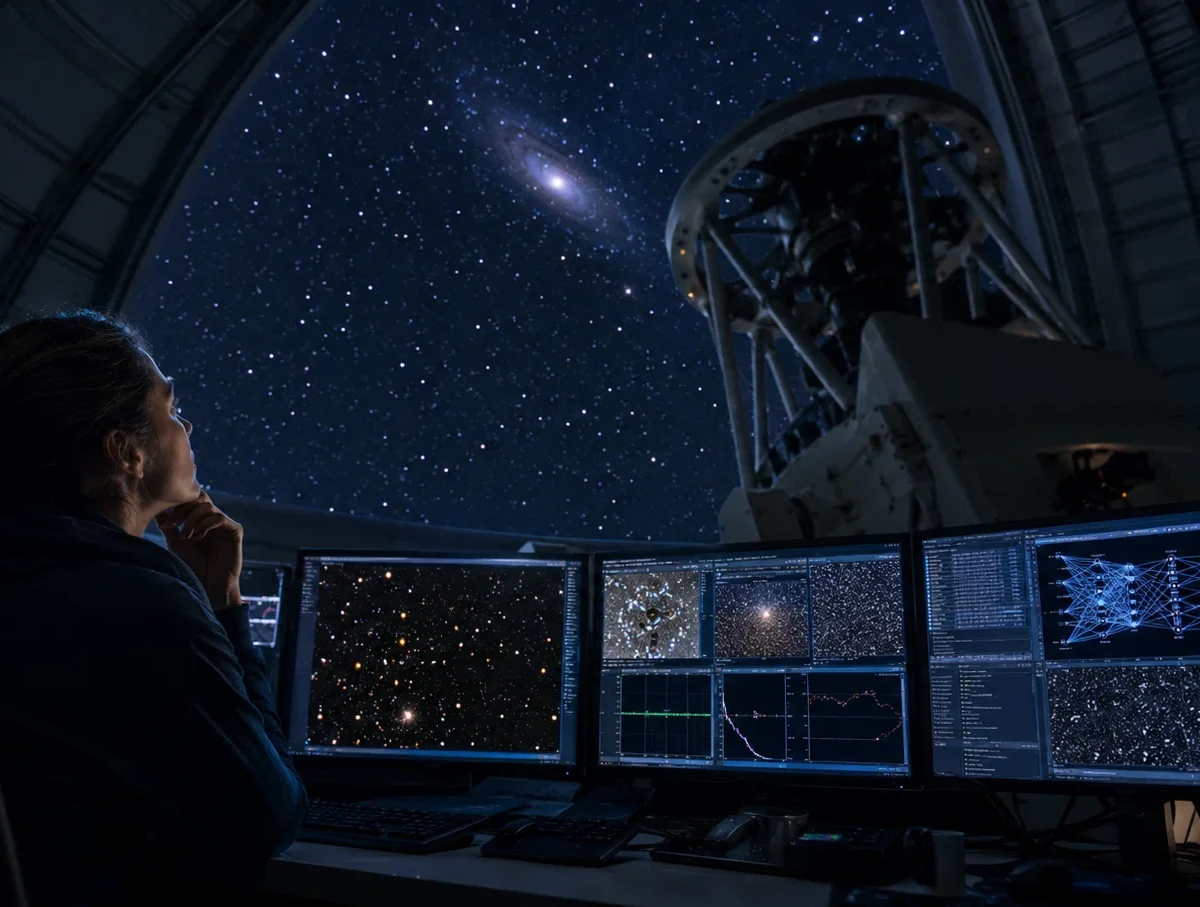
One afternoon in April, Cecilia Garraffo sat at the head of a conference room table in Cambridge, Massachusetts, and looked out at what might be the last generation of astrophysicists of their kind.
The walls of this room had previously echoed with the noise of thousands of other scientific gatherings. Now, as shafts of sunlight streamed in, the conversation shifted toward nonhuman collaborators. One after another, the assembled researchers explained how they intended to use machine learning in astronomy: tracking an interstellar comet, identifying faint galactic filaments at the largest cosmic scales, and designing a new “tokenizer” capable of converting astrophysical images into formats more easily processed by artificial intelligence (AI).
“Sometimes models will be overconfident,” Garraffo warned a junior colleague.
After the meeting ended and everyone began to leave, black hole researcher Daniel Palumbo made a brief announcement. Representatives from AI chip manufacturer NVIDIA were on campus seeking scientists interested in using their hardware for research problems. For anyone needing additional computational power, “today’s the day,” he said.
The Center for Astrophysics | Harvard & Smithsonian, based in Cambridge, employs more than 600 astronomers locally and over 800 in total, making it one of the largest concentrations of professional astronomers in the world. Garraffo leads its AstroAI group, which focuses on integrating machine learning into various areas of astrophysical research. In just four years since its proposal, she and her colleagues have established collaborations across the institution and with industry labs such as Google DeepMind and Anthropic.
Initially, their aim was to apply machine learning to remove technical computational barriers while preserving what Garraffo sees as the most meaningful part of physics: formulating scientific questions. Their toolkit did not originally include chatbots. Despite the rapid rise of ChatGPT, released shortly after AstroAI was proposed, Garraffo expected the group to avoid large language models (LLMs).
That assumption, however, has recently changed.
Reports of extraordinary progress began circulating within the institution. As Garraffo’s MacBook Air slowed to a crawl due to a locally running AI agent, her colleague Alyssa Goodman demonstrated a data-fitting problem involving the motion of spiral arms in a distant galaxy. For years, her team had struggled to isolate this motion from other distortions in the data caused by geometry and rotation. She posed the question to ChatGPT, which solved it within minutes. Her group is now preparing multiple papers based on the resulting dataset, described as “the single best map of spiral arm kinematics ever—by a factor of 100.”
Conversations comparing these systems to human researchers, once informal and rare, have become increasingly common across astrophysics departments worldwide. Researchers are now using agentic AI systems such as Anthropic’s Claude or OpenAI’s Codex for literature reviews, code generation, telescope proposal drafting, and even preliminary evaluation of peer submissions.
Institutions such as the Space Telescope Science Institute and the Institute for Advanced Study have begun organizing meetings on LLMs and AI agents in scientific research. In March, Anthropic published a blog post by Harvard physicist Matthew Schwartz describing experiments in “vibe physics.” After carefully supervising Claude to prevent errors and hallucinations, he reportedly guided it to produce a publishable physics paper in two weeks—a task that would normally take a year. Schwartz suggested the system resembled a “second-year graduate student,” and speculated that continued progress could soon match postdoctoral researchers.
Representatives from AI companies increasingly present astrophysics as a showcase for their technologies. Some even describe the automation of astronomical research as a strategic goal. In February, as Elon Musk’s SpaceX pursued plans for orbiting data centers, the company described its broader ambition as “scaling to make a sentient Sun to understand the Universe.”
Already, AI tools are accelerating paper production and increasing pressure on academic journals and reviewers. Many scientists fear that, if widely deployed across the research pipeline, these systems could fundamentally reshape astrophysics as a human discipline. Some even warn of a potential “end” of astrophysics as a human endeavor.
“A lot of people think that it’s too late to intervene—we’re done,” says David Hogg, a computational astrophysicist at New York University.
Although concerns about AI displacement are widespread across society, astrophysics represents a particularly unusual case. The field is largely computational, heavily dependent on data analysis and mathematical modeling, making it especially vulnerable to automation. Yet it also carries strong cultural and philosophical weight: astronomy has long symbolized human curiosity and progress.
At the same time, astrophysics offers limited direct economic or medical benefits, meaning it is less constrained by immediate practical necessity than fields like drug discovery. This raises the question of whether it can develop a balanced, human-centered relationship with AI—or whether it will be transformed beyond recognition.
Early Signs: Mixed Outcomes
In September 2025, a guest speaker at New York University’s physics department demonstrated an AI agent running in real time behind their lecture. The system—called Denario and developed by researchers at the Flatiron Institute—automatically generated research ideas, performed analyses, and produced near-complete scientific papers on the fly. Some results were nonsensical, others plausible.
The speaker suggested that graduate students might no longer be necessary.
“You don’t need grad students anymore.”
This comment angered many in the audience. One graduate student, Matthew Daunt, later said the outputs did not appear scientifically useful despite their speed. Another researcher, David Hogg, who works at Flatiron, met with him afterward.
“He was like, ‘I’m not cattle,’” Hogg recalled.
The episode led Hogg to reflect on the ethical and philosophical implications of AI in science. He argued that outright banning AI would be impractical, but unrestricted use could overwhelm the field with machine-generated papers faster than humans could evaluate them.
In February, he published a preprint titled: “Why do we do astrophysics?”
His conclusion emphasized that astrophysics is not only about results, but about the process itself. Graduate students are not merely labor, but future scientists shaped through participation in research.
“Anyone working in astrophysics,” Hogg wrote, “is someone who wants to do astrophysics, not someone who wants to learn the answers.”
Responses were mixed. Some colleagues expressed disagreement, while others appreciated the discussion. Within institutions like Flatiron, conversations about AI timelines and consequences reportedly accelerated dramatically.
A Historical Perspective on Computation in Astronomy
Astronomy has long been intertwined with computation. Ancient civilizations—from Mesopotamia to China—used mathematical records of the sky as early forms of data science.
In the second century BCE, Hipparchus analyzed Babylonian observations to model celestial motion. In the 17th century, Johannes Kepler derived planetary laws from Tycho Brahe’s data.
As astronomical datasets expanded, “human computers” emerged—teams of people performing calculations by hand. During the French Revolution, displaced workers were even employed to compute logarithmic tables. In the 19th century, Charles Babbage designed early mechanical computing systems partly inspired by astronomical calculation needs.
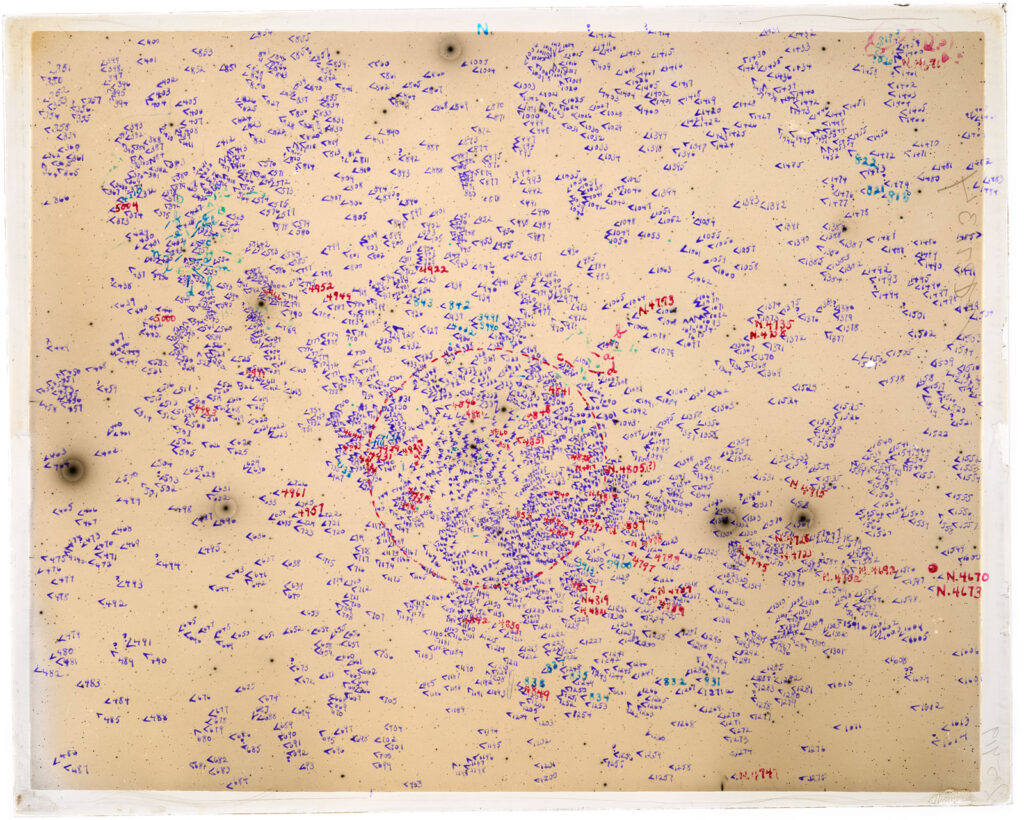
By the late 1800s, photography transformed astronomy again, generating massive archives of glass plates stored at institutions like Harvard Observatory. To process this data, women known as “computers” performed detailed classification work, often without recognition.
One such contributor, Muriel Mussells Seyfert, helped analyze photographic plates that later contributed to understanding galaxy clusters. Her work indirectly supported early evidence for what would later be known as dark matter. Decades later, Vera Rubin would build on similar data to provide stronger evidence for its existence.
AI, Industry, and the Future of Discovery
In March, NVIDIA announced hardware designed for orbital data center systems. Some researchers worry such technologies could pollute astronomical observations while also accelerating AI-driven analysis of the cosmos.
When asked about a future in which human discovery becomes less central, Garraffo emphasized her motivation:
“What I love is to chase the truth.”
She acknowledged that historical astronomical work often involved tedious effort, but argued that if AI can accelerate discovery, it should be used.
However, she remains unconvinced that current LLMs can match human scientific reasoning. In experiments where she asked systems like Claude and ChatGPT to solve complex equations in modified general relativity (Einstein-Gauss-Bonnet gravity), the models produced incorrect or superficially plausible but ultimately flawed results.
Even so, she believes that if AI progress were to plateau at a level where it assists without replacing human reasoning, it would be ideal.
“Then we have to press the brakes.”
Acceleration and Anxiety
Some researchers now believe AI is approaching or surpassing that boundary.
Postdoctoral researcher Rodrigo Córdova Rosado described using Claude to generate a full physics textbook, complete with exercises and computational scripts. While impressed, he also expressed concern about overreliance.
“This is a wave,” he said. “If you do not surf it, it feels like you’re gonna get drowned by it.”
Within AstroAI, internal discussions have become increasingly philosophical: whether AI lacks scientific “taste,” whether it democratizes or centralizes research power, and whether probabilistic models can be trusted for rigorous mathematical work.
Researchers broadly identify two major concerns:
First, AI may destabilize scientific evaluation systems. If generating publishable work becomes trivial, journals may be overwhelmed, forcing stricter and possibly arbitrary gatekeeping.
Second, there is fear of “deskilling,” where younger scientists fail to develop core reasoning abilities because AI systems handle too much of the intellectual workload.
Some warn this could lead to long-term erosion of scientific capability itself.
A Field Under Pressure
Journal editors report rising submission volumes and increasing difficulty finding reviewers. Some submissions appear to be fully or partially AI-generated, sometimes without disclosure.
Ethan Vishniac of the American Astronomical Society noted that the volume of low-quality submissions risks overwhelming peer review systems.
“The quantity of things of low quality can strangle the system,” he said.
Meanwhile, some scientists argue that the academic incentive structure—based on publication counts and citations—may no longer function effectively in an AI-augmented environment.
What Is Astrophysics For?
For David Hogg, the debate ultimately became philosophical. In his view, astrophysics is not only about knowledge production, but about human intellectual development.
Graduate training, he argued, is not just a step toward expertise but an essential part of becoming a scientist.
The reaction to his essay was intense, with many researchers engaging in heated discussions about the future of the field.
Some feared that within a short time, AI systems could reduce human participation in research to a symbolic role.
Others were more cautious, arguing that AI still lacks true scientific judgment.
Human Meaning in a Machine Age
Despite the tension, many researchers still frame astrophysics as a deeply human pursuit.
One anonymous graduate student noted that while AI tools are widely used, scientists remain skeptical of full replacement.
Another researcher, Rafael Martínez-Galarza, emphasized the cultural and existential dimension of astronomy:
“I see value in the process of matter turning into neurons trying to understand itself. I think it’s beautiful—it’s almost poetic.”
He argued that science is not merely about efficiency or results, but about shared human effort.
Even if AI could drastically accelerate discovery, he questioned whether that should always be the goal.
“I don’t see why we would rush colonizing the Galaxy or even understanding the universe, if that means a step back in the human experience,” he said. “I don’t see the point.”